
The Case for Strength: Why It Matters

Strength training isn’t just about getting stronger—it’s one of the most powerful tools for healthy aging. Building strength can help you live longer, boost your mood, support cognitive function, and improve bone density. Even simple daily movements, like getting in and out of a chair, rely on coordinated strength across multiple joints and muscles.
In general, it's wise to incorporate strength training twice per week. Be sure to warm up with dynamic movements for about 5 to 10 minutes before starting. For example, you might do arm circles before shoulder exercises. Before squats or deadlifts, sit with your knees bent and feet wide, then gently windshield-wiper your knees side to side. From tabletop, move one hip through its full range of motion: lift your knee, open it to the side, extend it back, then draw it toward your chest. Repeat a few times on each side.
Most of your everyday tasks involve one of these six movements: hinge, squat, lunge, push, pull, and rotate. Training these patterns helps build functional strength you can use in real life.
If you have any medical conditions, joint replacements, or current pain, consult your health care provider before making major changes to your routine.
Master the Hinge
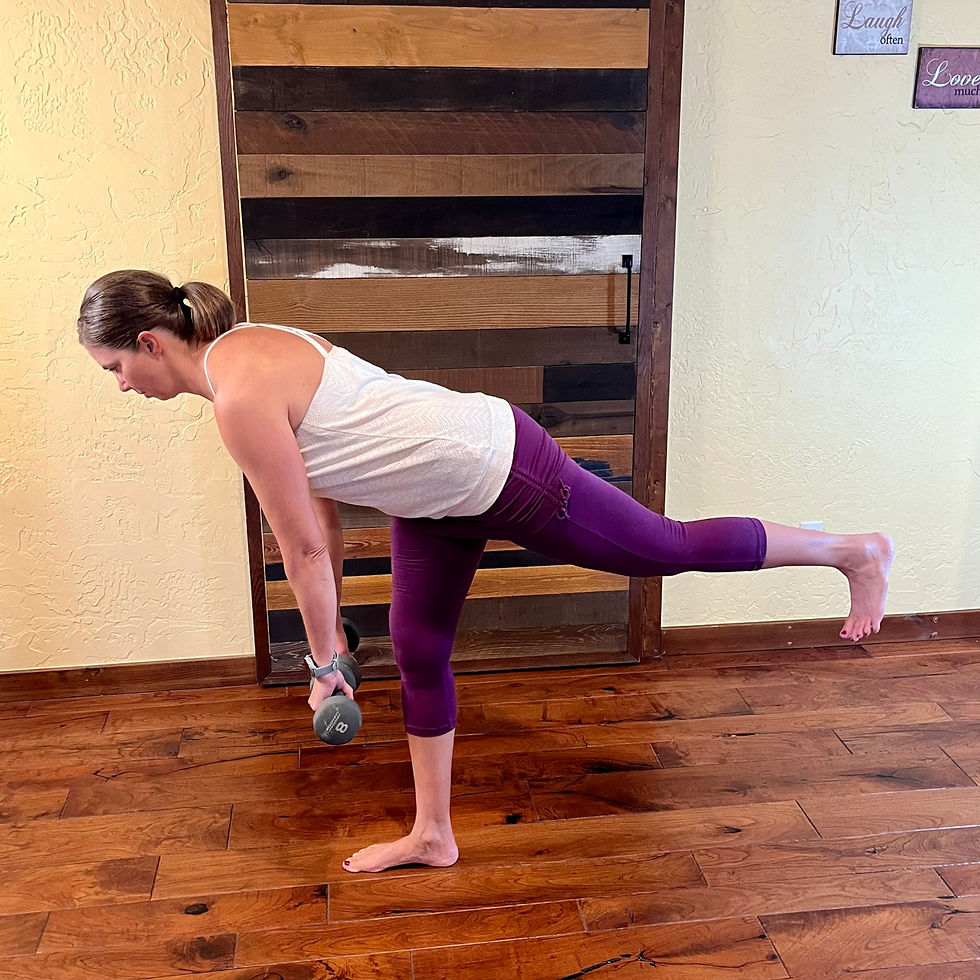
An exercise like a deadlift can help stabilize your core when lifting a heavy object from the floor, which in everyday life might mean picking up your child or lifting bags of groceries. You can start without weights to master hinging at your hips while keeping your shoulders and hips parallel to the floor. Gradually increase the difficulty by adding weight with a kettlebell or dumbbells. Eventually, you might incorporate balance by performing a single-leg deadlift, as shown in the photo above and described below.
Single Leg Deadlift:
Stand with feet hip-width apart. Shift your weight into your right leg with a slight bend in the knee. Hinge forward as your left leg lifts behind you, keeping your hips square. Return to standing. To progress, hold dumbbells in front of your hips. Lower them along your standing leg until you feel a stretch in your hamstrings, then return to standing. Perform 8–12 reps, then switch sides.
Use Compound Movements to Build Strength and Balance
Incorporate these compound exercises to train multiple movement patterns at once, including lunge-and-pull and squat-and-push.
Squat to Shoulder Press:
Stand with your feet hip-width apart, holding dumbbells at your shoulders. Lower into a squat, then press through your feet to stand as you lift the weights overhead. Lower the weights with control and repeat for 8–12 repetitions. To modify, do the squat without weights or separate the squat from the press.
Reverse Lunge to Bicep Curl:
Stand with your feet together, holding dumbbells in your hands, palms facing forward. Step your right leg back into a reverse lunge, then bring your foot back to meet your left and perform a bicep curl. To add balance work, instead of stepping together, lift your knee toward your chest, then step back again. Repeat on the same leg for about 30 seconds, then switch sides.
Wake Up Your Glutes
After sitting most of the day, you might develop what's commonly called 'dead butt syndrome', where the gluteus medius struggles to engage. When this muscle is weak, it can negatively affect the areas that take on the extra load. You can strengthen the gluteus medius with the following exercise.
Side Lying Leg Lifts:
Lie on your side with your head propped on your hand or resting on your arm. Use your other hand in front of you for stability. Straighten your legs with your feet at the corner of your mat. Keep your hips stacked, lift and lower the top leg with your toes pointed down. Repeat for 15 reps to start (gradually increase as you build strength). Then switch sides.
Avoid the Plateau
To increase your strength, you have to challenge your muscles beyond your current capacity. When you first start strength training, gains often come quickly. But over time, your muscles adapt. If you keep using the same weight and repetitions, progress stalls. To continue building strength, gradually increase resistance, reps, or complexity.
In addition to strength training, aim to include moderate-to-vigorous cardio at least twice per week. Choose activities like biking, swimming, dancing, or rowing—anything that elevates your heart rate and leaves you slightly breathless.
Rest and Recovery
Make time for rest and recovery, and be sure to stretch. Injuries are most common when you push too hard, too fast. When your muscles reach their limits, the joints and tendons often take on more of the load, increasing the risk of injury. This is especially true with unfamiliar movements. If you’re new to lifting weights, move slowly through each exercise to ensure you’re engaging the right muscles and using proper form. Allow about 48 hours of rest after working a particular muscle group.
Practices like yin yoga can complement strength work by supporting connective tissue health and maintaining range of motion. You can explore more in my recent Triathlete article on the benefits of long-held poses like Caterpillar.
Strength training is one of the most effective ways to support longevity, resilience, and everyday function. Pair it with smart recovery, mobility work, and consistent movement, and you create a foundation for lifelong health.



Comments